

ESG Consulting and Management
Environmental, Social, Governance – ESG – stands for a holistic business practice that measures and evaluates not only economic parameters, but also the effects of economic activity on the environment, on society, and on corporate management. In this way, ESG minimizes future risks and creates incentives for successful long-term sustainable strategies. Drees & Sommer Switzerland is guided by the ESG regulations and helps customers introduce and comply with them.
WHAT DOES ESG STAND FOR?
ESG stands for Environmental, Social (and Corporate) Governance. It refers to a business practice that, in addition to economic success, also strives to make improvements in these three areas. Compliance with ESG principles results in the creation of sustainability-oriented industrial and financial products.
Many regulations and instruments with specific criteria and indicators have been published in recent years that allow developments and progress in these three areas to be measured and compared. The aim is for the areas E, S and G to be seen as opportunities for creating a sustainable future so that entrepreneurial activity can be aligned accordingly. Until recently, companies have undertaken the systematic assessment of opportunities and risks based on such economic factors as their capital resources or market value. In the future, sustainability and ESG principles will also be crucial elements of such assessments.
WHY IS ESG RELEVANT TO YOUR COMPANY?
- Increasingly, sustainability criteria are seen as an entrepreneurial duty and not simply an option.
- Keyword ‘divestment’: Investors and stakeholders evaluate their investments according to ESG criteria. Fulfillment of these criteria offers opportunities today, whereas non-fulfillment represents a future financial risk.
- Your customers and business partners expect transparency and disclosure, added to which the demand for genuinely environmentally and socially responsible products is steadily increasing.
- Buildings and infrastructure have the largest ecological footprint. From an investor’s point of view, real estate, as a long-term asset class, is particularly exposed to the risk of high loss of value – with the risk of turning into stranded assets.
- Sustainable business models will dominate the market in the medium to long term, so a sustainability strategy with clear objectives will give you a decisive competitive edge.
ESG REQUIREMENTS IN SWITZERLAND
For Swiss companies, ESG has long evolved beyond a voluntary commitment. Regulatory requirements, expectations from investors and financial institutions, as well as international supply and value chains, are increasing the demand for transparent and reliable sustainability information.
In Switzerland, certain companies are already subject to non-financial reporting requirements. They must disclose risks and measures related to environmental, social, and employee matters, human rights, and anti-corruption efforts. Regulatory requirements continue to evolve and are becoming increasingly aligned with international standards.
Even Swiss companies that are not directly subject to mandatory sustainability reporting may be affected indirectly—for example through international supply chains, business activities within the European Union, or information requests from customers, investors, and financing partners.
Developing an ESG strategy at an early stage helps organizations identify relevant requirements, establish robust data structures, and effectively integrate sustainability objectives into existing business processes.
WHAT DOES THIS MEAN FOR SWISS COMPANIES?
Depending on a company's size, industry, business activities, and real estate portfolio, different questions may arise:
- Which reporting and due diligence requirements apply to our organization?
- What are the expectations of investors, banks, and business partners?
- How do European regulations affect our business activities?
- Which sustainability data is required today and in the future?
- How can ESG risks be identified and managed at an early stage?
- How can sustainability objectives be translated into concrete and measurable actions?
Drees & Sommer Switzerland helps you identify the ESG requirements relevant to your organization and develop a practical roadmap for successful implementation.
WHAT ESG STRATEGY ARE YOU PURSUING?
Compliance-oriented
Numerous regulations, many of them complex and far-reaching, have emerged for different market players following the Paris Climate Agreement and Agenda 2030 (Sustainable Development Goals, SDGs). It is important to stay abreast of evolving sustainability systems to ensure that your business activity remains lawful and compliant in the future, and to meet the EU’s ESG criteria. It is also essential to manage sustainability risks and be in a position to act with suitable tools and strategies. We can support you in these areas.
Future-oriented
The sustainability megatrend requires adapted or completely new business models. But it also opens up huge opportunities. Our future-oriented consulting undertakes a 360-degree view with you and supports you on your way to becoming a successful sustainability pioneer – with measures ranging from a Quick Check to developing and implementing an appropriate strategy and reporting.
Whether you want to establish legally compliant reporting or to establish your company as a sustainable pioneer in your sector, we can offer a custom-fit solution.
-

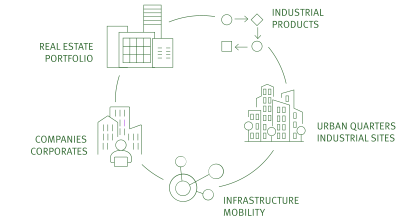
Companies
-

Real estate and portfolio
-

Urban neighborhoods and industrial sites
-

Infrastructure and mobility
OUR ESG SOLUTIONS
Organizations begin their ESG journey from different starting points. Some first need greater transparency regarding their existing data and risk exposure, while others have already defined sustainability goals but require support to translate them into practical implementation.
Our approach is therefore tailored to your individual requirements.
Drees & Sommer Switzerland combines ESG consulting with in-depth technical real estate expertise. This enables us to develop strategies that go beyond high-level objectives and are translated into practical measures for buildings, sites, and real estate portfolios.
Whether it concerns the business model, product design, portfolio strategy, or property and infrastructure project, we work with you to gain an overview of the status quo. Before we support you on the path to a sustainable, ESG-compliant future, the starting point of the journey should be clearly defined.
How we can support you:
- Asset and portfolio analysis
- ESG risk analysis
- Materiality analysis
- 360° analysis
- Carbon footprint analysis
- Energy audit
- Green/ESG due diligence
- Climate risk analysis
On a short trip out into nature or a trip around the world, we show you the variety of solutions for a sustainable future and always keep your feet on the ground. Our experts know the challenges of your industry and are equipped with the right technical solution.
How we can support you:
- Sustainable finance consulting
- Circular economy consulting
- CO2 neutrality
- Green bond consulting
- Green building/green city consulting
- Mobility consulting
- Sustainability/climate strategy
We will not leave you unaccompanied. Rather, we implement the desired changes together with you. Whether new construction, refurbishment, or product development, successful projects are our USP. Our management expertise ensures that the budget, quality, and time frame of the project, in addition to the ESG criteria, are adhered to.
How we can support you:
- CO2 reduction pathway
- Project management office
- Green building certification (in accordance with SNBS, DGNB/SGNI, Minergie/Minergie-ECO, LEED, BREEAM, etc.)
- Organizational and process consulting
- Change and communication management
- Portfolio evaluation (in accordance with GRESB, EU Taxonomy, etc.)
Your CFO needs it and your customers want it: transparency on sustainability so that the green promise is not washed out. We help you find the right reporting for your stakeholders.
How we can support you:
- Corporate reporting (in accordance with GRI, etc.)
- Impact reporting
- Green building certification (in accordance with SNBS, DGNB/SGNI, Minergie/Minergie-ECO, LEED, BREEAM, etc.)
- Cradle-to-cradle certification
- Energy and environment management (in accordance with ISO 50.001, 14.001, etc.)
How do we implement ESG?

Frequently Asked Questions About ESG and Regulatory Requirements
Although many ESG regulations originate in the European Union, they can also affect Swiss companies. This is particularly true for organizations with subsidiaries in the EU, business relationships with European partners, or international supply chains. Depending on a company's structure and operations, the Corporate Sustainability Reporting Directive (CSRD) and other European sustainability requirements may apply.
The Corporate Sustainability Reporting Directive (CSRD) is an EU directive that expands sustainability reporting requirements. It introduces standardized reporting requirements for environmental, social, and governance (ESG) topics across the European Union. Its objective is to improve the transparency, consistency, and comparability of sustainability information.
The EU Taxonomy defines which economic activities are considered environmentally sustainable. For property owners, investors, and developers, it provides a framework for assessing the sustainability performance of real estate assets and guiding investment decisions. Swiss market participants may also be affected when operating in European capital markets or working with international investors.
The European Sustainability Reporting Standards (ESRS) specify the reporting requirements under the CSRD. They define which sustainability information organizations must disclose and how it should be reported. Topics include climate change, resource use, biodiversity, workforce issues, and corporate governance.
Double materiality evaluates sustainability from two perspectives: first, how an organization's activities affect people and the environment, and second, how sustainability-related risks and opportunities impact the organization's financial performance. It is a core principle of the European sustainability reporting framework.
Establishing an ESG strategy early helps organizations prepare for evolving regulatory requirements and integrate sustainability into business decisions. It also strengthens transparency for investors and financial institutions, supports better investment decisions, and embeds long-term sustainability objectives into corporate and real estate strategies.
Drees & Sommer helps organizations interpret regulatory requirements, develop ESG strategies, and implement practical solutions. Our services include assessing the current situation, developing implementation roadmaps, integrating ESG criteria into real estate and infrastructure projects, and supporting reporting and transformation initiatives.
Even without a legal obligation, investors, lenders, business partners, and customers increasingly expect transparent and credible sustainability strategies. Organizations that integrate ESG principles early can reduce risks, identify new opportunities, and strengthen their long-term competitiveness.
Let's talk.
We look forward to hearing from you!
Ivo Angehrn, Head of Sustainability and Climate Solutions
ivo.angehrn(at)dreso.com, +41 79 298 50 24
Vera Künzli, Leading Consultant Sustainability and Climate Solutions
vera.kuenzli(at)dreso.com, +41 79 843 81 16

