


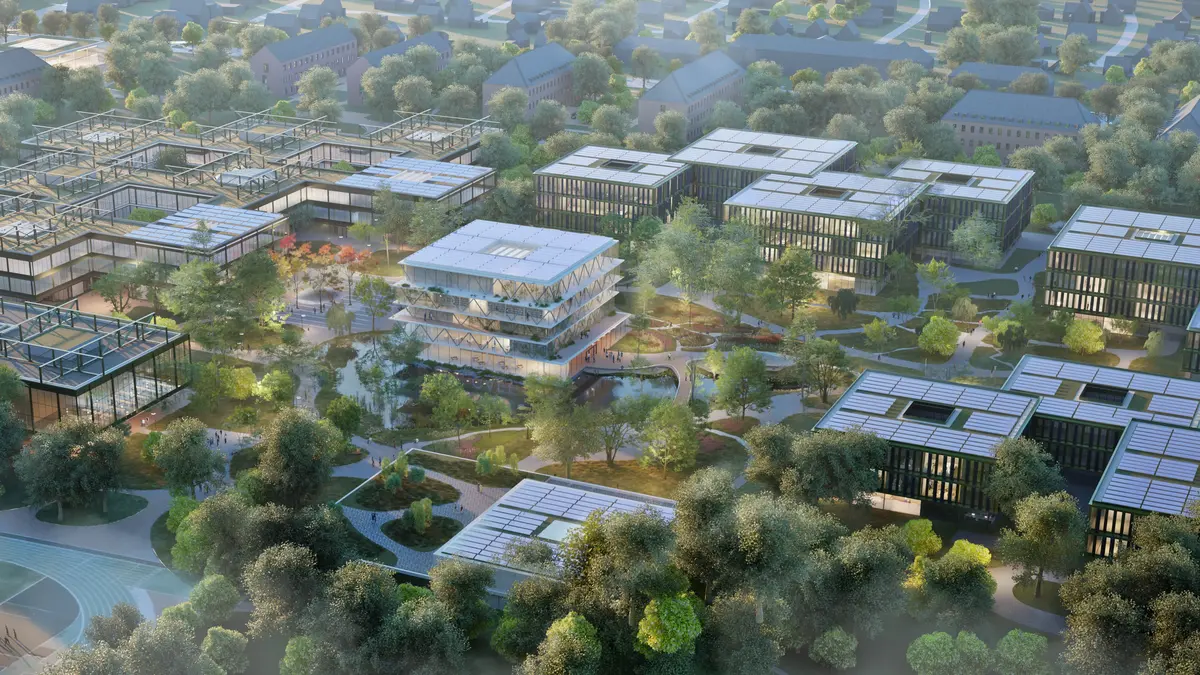
Hamburg, Germany, January 3, 2025. A university campus that not only imparts knowledge and promotes research, but also serves as a model of climate action. This is the aim of the planned campus development of the Helmut Schmidt University, based in Hamburg’s Jenfeld district. The existing campus in the east of the Hanseatic city, which is currently home to around 2,500 students and more than 1,000 members of staff, is to be restructured during semester time. The master plan provides for the creation of a highly livable, climate-neutral campus and the construction of state-of-the-art learning environments using sustainable construction methods. The planned work includes the use of regional and recyclable building materials, comprehensive greening and active water management. Drees & Sommer SE will provide support to the university in this ‘transformation to sustainability’ project. The company specializes in construction, real estate and infrastructure consulting. The planning is based on the award-winning competition design by Stuttgart-based h4a Gessert + Randecker Architekten with Glück Landschaftsarchitektur, which is now being jointly realised.
“In the coming years, the gross floor area of the university campus will grow from about 88,000 to 107,000 square meters due to comprehensive new construction and restructuring activities. The overall costs of the project will be almost one billion euros,” says Professor Dr. Klaus Beckmann, President of Helmut Schmidt University. The work is being carried out during semester time, while university life continues as usual. This will be made possible by the completion of the work in several construction phases, with the individual pieces of the jigsaw puzzle, in the form of the different building sites, gradually coming together. “The new campus will contribute to climate change mitigation in future and, at the same time, create an attractive space for innovation and community, which will have a long-term positive impact on the university,” explains Dr. Beckmann.
New Campus Master Plan with Sustainable Mobility and Innovative Greening Solutions
The newly-developed master plan brings new vitality to the campus: The design includes not only green roofs, but also targeted planting of the grounds, which will have a cooling effect in the hot summer months. Gregor Grassl, Associate Partner and expert for climate-friendly construction and urban development at Drees & Sommer, explains it with figures: “Gravel or bitumen roofs heat up to as much as 40 or 55 degrees Celsius in summer. However, green roofs can potentially reduce the surface temperature by as much as 25 degrees. This has a positive effect on the climate of the immediate surroundings and on biodiversity. As green lungs, roofs with greenery also produce oxygen and reduce pollutants.“ The existing trees are also being taken into account in the plan: depending on their condition, they will be retained, added to, or completely replaced.
The restructuring of the campus will concentrate future teaching and study activities in the middle of the campus, with the centrally located buildings being surrounded by a green strip. A specially built mobility hub on the main access road will ensure that the campus remains almost traffic-free – apart from delivery vehicles that facilitate the management of the campus and which will continue to be able to reach all necessary areas via a circular road. The university is also promoting environmentally-friendly mobility on the campus by providing scooters and bicycles, in addition to an extended network of paths with several bike parking facilities at all buildings. This will make the campus not only greener, but also more lively.
Forward-Looking Strategies and Sustainable Energy Supply
Jörg De Tommaso, Head of Project at Drees & Sommer, believes it is important that the existing local potential for renewable energies be used in the remodeling of existing buildings and the construction of new ones on the campus, to assist its transformation to a more sustainable future and to facilitate the move away from fossil fuels. Drees & Sommer’s Head of Project comments: “In drawing up a climate-neutral energy plan, the designers considered the challenges of building operation alongside the research requirements, while placing particular emphasis on security of supply. An innovative technology mix, which combines solar energy, groundwater and wastewater energy, along with waste heat from the new data center, will help to create a future-proof and climate-neutral energy supply infrastructure at the research site.”
With regard to the sustainability aspects, Jörg De Tommaso adds: “We are taking an innovative approach to redeveloping the campus that recognizes the value of existing structures and combines the old and the new in a harmonious way. In this way we can ensure that the existing structures are integrated effectively into the new designs and that we do not demolish unnecessarily anything that could continue to be used.” Building materials from the region are being employed for the construction of any new buildings. The planned materials are also reusable and recyclable, which helps to reduce considerably the environmental impact.
The Sponge City Principle: Active Water Management Helps to Mitigate Climate Change and to Conserve Biodiversity
The layout of the buildings on the campus will be especially beneficial in respect of the active water management system, which is based on the principle of the sponge city. In a sponge city, large retention areas are created to enable rainwater to percolate into, evaporate from or be retained by the planted areas. This means, both figuratively and literally, that areas absorb water like a sponge. This reduces the risk of flooding, and the water can be used to water the plants, which has a positive effect on biodiversity.[i] This principle is becoming increasingly important in times of climate change and more frequently recurring weather extremes.
Drees & Sommer’s team of specialists has developed this master plan for sustainable transformation in cooperation with Stuttgart-based experts from h4a Gessert + Randecker Architekten GmbH, Glück Landschaftsarchitektur and Brenner Plan GmbH.
[i]Schwammstadt - die Zukunft der Stadtentwicklung | AFRY
(in German; Sponge City – the future of urban development)