


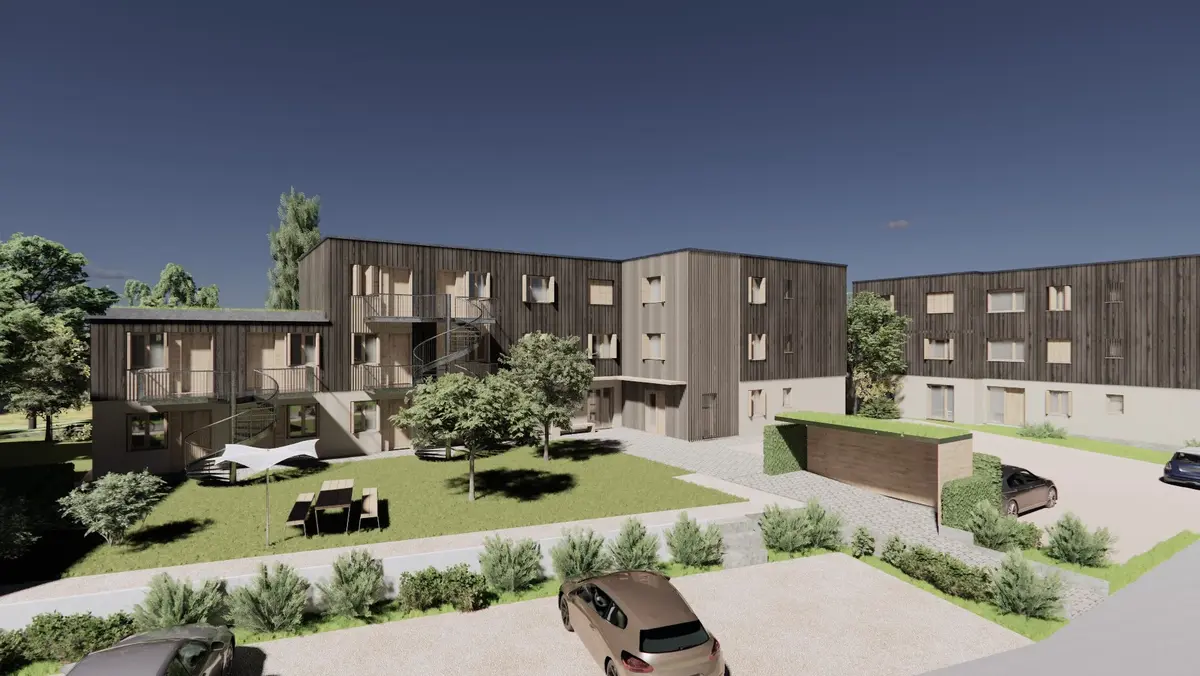
Heidelberg, Germany, November 19, 2024. Heidelberg-based Gesellschaft für Grund- und Hausbesitz mbH (GGH) is currently building 99 apartments for the employees of Heidelberg University Hospital (UKHD) nearby Neuenheimer Feld. Drees & Sommer SE, a company which specializes in construction and real estate, supports GGH with its services in this project. The shell work was completed at the end of October, with the new tenants due to move into the apartments in June 2025. A total of 3,170 square meters of living space will be created on the 4,500 square meter site, spread over five detached L-shaped buildings, each two to three-stories high. The 99 apartments are mainly designed as one-bedroom apartments with 25 to 30 square meters of living space, together with their own bathroom and kitchenette.
Once construction is completed in May 2025, UKHD will lease and manage the 99 apartments. GGH remains responsible for the roof and structure, and thus for the maintenance and repair of the buildings. "This project enables us to create affordable living space for university hospital employees. In this way we are actively contributing to ensuring a supply of skilled workers in our city," explains GGH Managing Director Peter Bresinski. In order to meet its own objective of sustainable construction methods, GGH is focusing on modular timber hybrid construction.
The Root of all Building
Timber has a long tradition as a building material. Although now replaced by concrete and cement, it is drawing increased attention again in view of climate change and the lack of resources.
As a renewable raw material that is available locally and stores CO2, the life cycle assessment of wood is very good. Combined with its excellent thermal, structural and weatherproofing properties, wood is an outstanding building material. A further advantage is that wood is easy to process and enables modules to be prefabricated quickly and precisely. The individual elements are prefabricated in a manufacturing facility and in series. This ensures consistently high quality for each of the components, as the modules can be produced with millimeter precision. It also makes work on the building site quicker and easier: instead of installing each element as small-scale operations in the rain, snow and cold, complete system components for walls, ceilings and bathrooms are delivered. They are then simply joined together on the building site.
Everything on Schedule with Lean Construction Management
The construction process needs to be efficient so that tenants can move into the apartments in the summer. Drees & Sommer project head Benjamin Depner provides project management services to the client GGH. The project manager applies the principles of lean management In order to complete the construction project in line with the timescales. The method is borrowed from the automotive industry: automakers know exactly when there is a fault in the precisely timed production process. On a conventional building site, on the other hand, defects often go unnoticed for a long time, leading to subsequent errors. “The lean construction management method we have developed transfers the automotive industry approach to construction projects," explains Benjamin Depner. "The key element is detailed project progress planning that is scheduled exactly to the day. This clearly defines when which employees, machines and construction materials are needed at which location and at what time.” This results in a significant acceleration of work processes and an efficient building site.
Housing for Employees as an Advantage of the Location
For Andreas Kieb, housing expert at Drees & Sommer, the GGH solution could soon serve as a model: “Staff housing is more than just a fringe benefit. It is an important aspect of a location, especially in regions with high competitive pressure for skilled workers. A good supply of housing could be the deciding factor in whether a potential employee decides for or against a company.“ To reduce existing obstacles, the expert recommends a priority system based on the example of Munich. That city promises preferential approval for commercial sites to firms that build company-owned apartments. It would also be helpful to convert mixed-use areas into urban areas. However, implementing staff housing on a broad scale is still anything but easy: “Building houses takes time and requires local authorities and companies to act jointly,“ says Andreas Kieb. “However, companies can significantly reduce the cost of staff housing already today by taking advantage of subsidy programs and tax breaks. The effort for this always pays off in the long term.“
Simon Wieland, staff housing expert and project head at the research institute RegioKontext, confirms this development: “When the topic came up again about ten years ago, a rethink was initially needed. Many people still had the image of old company-owned apartments in mind: drab, gray and right next to the factories.” But this image is a thing of the past, in his view. “From our many years of consulting experience with employers, associations and the public sector, we know that staff housing combines elements of conventional company-owned housing with contemporary aspects such as modern floor layout, affordable prices and flexible models. Employers who have grasped that wage supplements do not build homes benefit from this,” continues the project head.
Ultimately, it is not only companies and their employees that benefit, but also the public sector: staff housing strengthens local economic cycles and helps to create affordable, needs-based residential space locally.


