











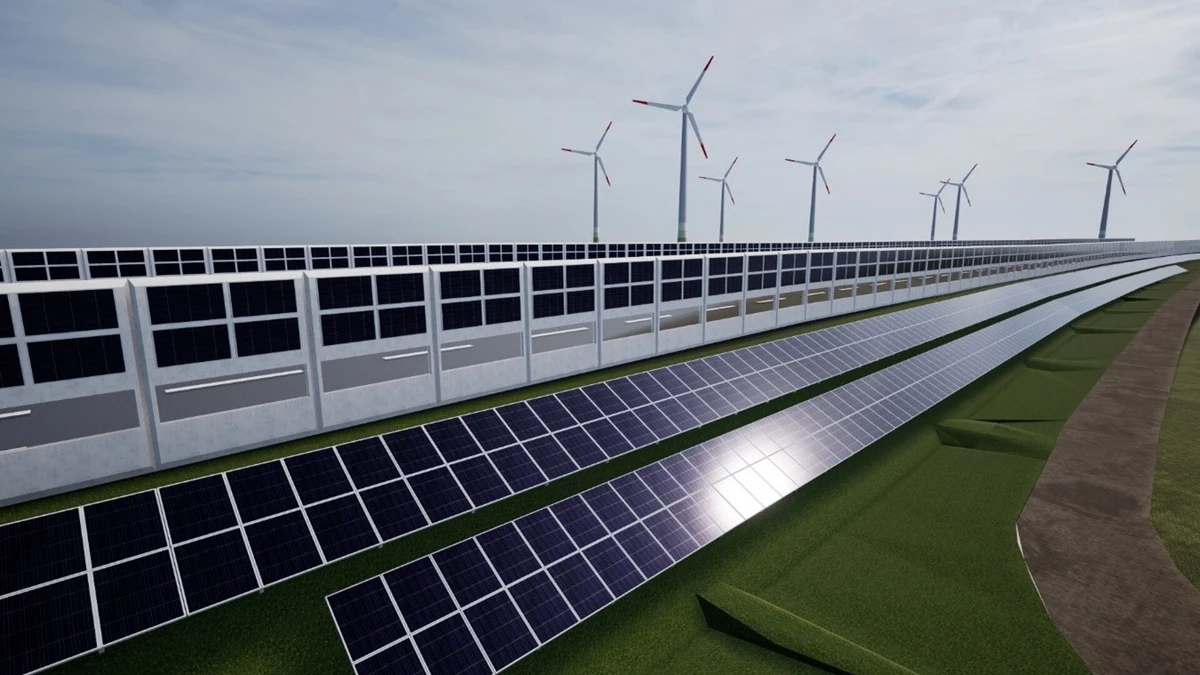

Erkelenz (Heinsberg district), Germany, December 18, 2024. While wind turbines and solar farms are often met with considerable resistance from the public, an innovative solution could literally pave the way to the future: solar motorways. A section of the Autobahn close to the Garzweiler opencast lignite mining pit in the German federal state of North Rhine-Westphalia is being considered as a suitable site for a flagship project. Drees & Sommer SE, a consulting firm which specializes in real estate and infrastructure, has produced a feasibility study for the local special-purpose association for the rehabilitation and repurposing of the land, Zweckverband Landfolge Garzweiler, which looks into ways of combining transport infrastructure with electricity generation to improve public acceptance.
Wind and sun instead of coal: in the Rhenish mining district, the energy transition is well underway. Wind turbines and solar panels are replacing environmentally harmful lignite, the mining of which in the past decades has left big scars on the landscape. If the structural transformation is successful here, it can give free rein to innovation – both in North Rhine-Westphalia and far beyond. Volker Mielchen, managing director of the special-purpose association Landfolge Garzweiler commented: “In densely-populated Germany, infrastructural projects encounter resistance.” Action groups protest against wind farms or the construction of power lines, and in many areas a battle is raging over the future use of the land.
Good Solution for the Battle Over Land Use
Founded in 2017, the special-purpose association and the renewable energies innovation park planned for the site (Innovationspark Erneuerbare Energien), tabled a possible solution for the period that will follow lignite-based electricity production: solar motorways. To produce the desired solar power not only neighboring roof spaces and greenfield areas will have to be used. Competing uses can indeed be accommodated. Volker Mielchen explained: “Routes and infrastructure can facilitate the production of renewable energy from solar panels on previously unutilized areas. This could create synergies between energy production and wind and noise protection.”
For this reason, as part of a sub-project of the Innovationspark Erneuerbare Energien structural transformation project, solar power systems are planned for embankments along the motorway A44n and on noise barriers on the motorway A46. Photovoltaic modules can also be mounted, vertically, on wind barriers.
Drees & Sommer’s Study Underpins the Technical and Economic Viability
The legal, technical and economic viability of carrying out the 24-megawatt project on the 30-kilometers motorway section was researched by Drees & Sommer in a feasibility study completed in August 2024. The experts analyzed issues including choice of technology, ease of implementation, and economic viability, as well as possible operator models and the time frames involved.
Alexander Vorkoeper, senior consultant at Drees & Sommer, added: “Our research has demonstrated the great potential of solar motorways for the development of sustainable infrastructure.” Of course, not every motorway section is suitable for the production of solar energy, as the senior consultant pointed out. As with projects involving open spaces, here too the systems have to be planned, mains connections established, applications for approval submitted – and so on. However, the expertise is there, and the design for the installation of solar panels along the motorway close to Garzweiler can be rolled out nationwide. “At 13,200 kilometers, Germany’s motorway network is the fourth-longest in the world,” the industrial engineer Alexander Vorkoeper noted.
The Fraunhofer Institute for Solar Energy Systems (ISE) has calculated that five percent of Germany’s land area is covered by transport routes, including not only motorways but also parking spaces and noise barriers. This holds the potential for 300 gigawatts of additional PV output. To put this in perspective, in April 2024 photovoltaic systems generating a total of 81.5 gigawatts were installed on German roofs and land.
Test Installation along the Motorway A81
The figures show how promising motorways are for generating energy. For that reason, it is not only the Rhenish mining district that is preparing to exploit this potential. In Ludwigsfelde, south of Berlin, the city government is planning to erect a solar roof over the motorway A10. Apart from being an efficient use of land, this will have other valuable synergistic effects in that it will reduce noise and protect the roadway from heat and rain. A small pilot system went into operation in the federal state of Baden-Württemberg in October 2023: cars and heavy goods vehicles drive under a five and a half meter-high roof made of photovoltaic modules through to the Hegau East rest and service area on the motorway A81. The Fraunhofer Institute is researching with partners the performance of the prototype in consideration of aspects such as stability, maintenance, drainage and road safety.
Anyone who frequently travels on motorways in Germany will have noticed that there are many solar farms alongside routes up and down the country, from the motorway A94 to the east of Munich and the motorway A7 at Hannoversch Münden, to the motorway A24 in Brandenburg. There, halfway between Hamburg and Berlin, solar panels on both sides of the roadway form a glittering pearl necklace. Planners have also set their sights on the federal roads. The municipality of Allensbach has acquired a solar power system with 3,400 panels, which is installed on a noise barrier along the four-lane upgrade of the federal road B33 in the district of Constance.
German Legislator Facilitates Construction of Installations along Long-Distance Roads
The legislative framework is defined in the German Renewable Energy Sources Act (EEG). The EEG categorizes corridors up to 200 meters’ distance from the edge of the roadway as privileged areas. The legislator has also recently relaxed the ban on erecting solar systems within 40 meters’ distance from the road. This means that, after examination of the individual case, the total area up to 200 meters can be used.
In addition to embankments or noise and wind barriers, experts have also considered using the road surface itself to generate solar energy using integrated panels, although not in Germany. An experiment on the D5 main road in Normandy in 2016 was unsuccessful due to the damage that the traffic caused to the road surface – including the solar cells. Engineers who built the first PV roadway in the world at Jinan in China at the end of 2017 met with greater success. Solar cells were incorporated into the surface beneath a transparent material. These generate a million kilowatt-hours of electricity per annum on 5,875 square meters – as much as is used by around 800 households per day.
A side note from the Netherlands, the cycling nation: A 70-meter solar bike path – the world’s first – was built near Amsterdam in 2014. It was a success, and after some teething problems the track surface managed to generate more electricity than initially forecast.
Expertise, Experience and Innovative Spirit
Back to Germany: a federal agency called Autobahn GmbH is responsible for operating the German motorways. To achieve climate neutrality in respect of the maintenance and operation of the motorway network by 2040, Autobahn GmbH plans to expand the use of photovoltaics gradually. Everything is in place to do this.
Alexander Vorkoeper pointed out: “Our study showed that solar motorways are economically viable. Communication with Autobahn GmbH, the landowner, should be continued now so that the next step can be taken.” The expertise and project experience necessary can all be found in-house at Drees & Sommer: more than 6,000 employees are currently overseeing around 6,500 construction, real estate and infrastructure projects worldwide.
For the special-purpose association Landfolge Garzweiler, the idea of the solar motorway is a momentous prospect, but it is not the only project planned. An integrated energy system will take care of the generation, storage, distribution and use of the renewable electricity generated all around the former opencast lignite mine. Managing director Volker Mielchen explained: “We want to remain an energy region, but without the lignite.’ The aim of the renewable energies innovation park project is to set up a large-scale integrated energy system for generating, storing, distributing and using the energy generated in five sub-projects. In addition to the solar motorway, the system includes the establishment of a multifunctional energy landscape, the energy plan for the inter-municipal industrial park Elsbachtal (Grevenbroich/Jüchen) as well as for the planned urban district of Jüchen-Süd, and for the Green Energy Hub, a state-of-the-art truck stop in the area of the municipality of Titz, which will focus on the generation and use of hydrogen. “It shows just how innovative we are. This is exactly what Germany needs,” concluded Volker Mielchen.


